Jhumka Earrings: The Story Behind the Bell
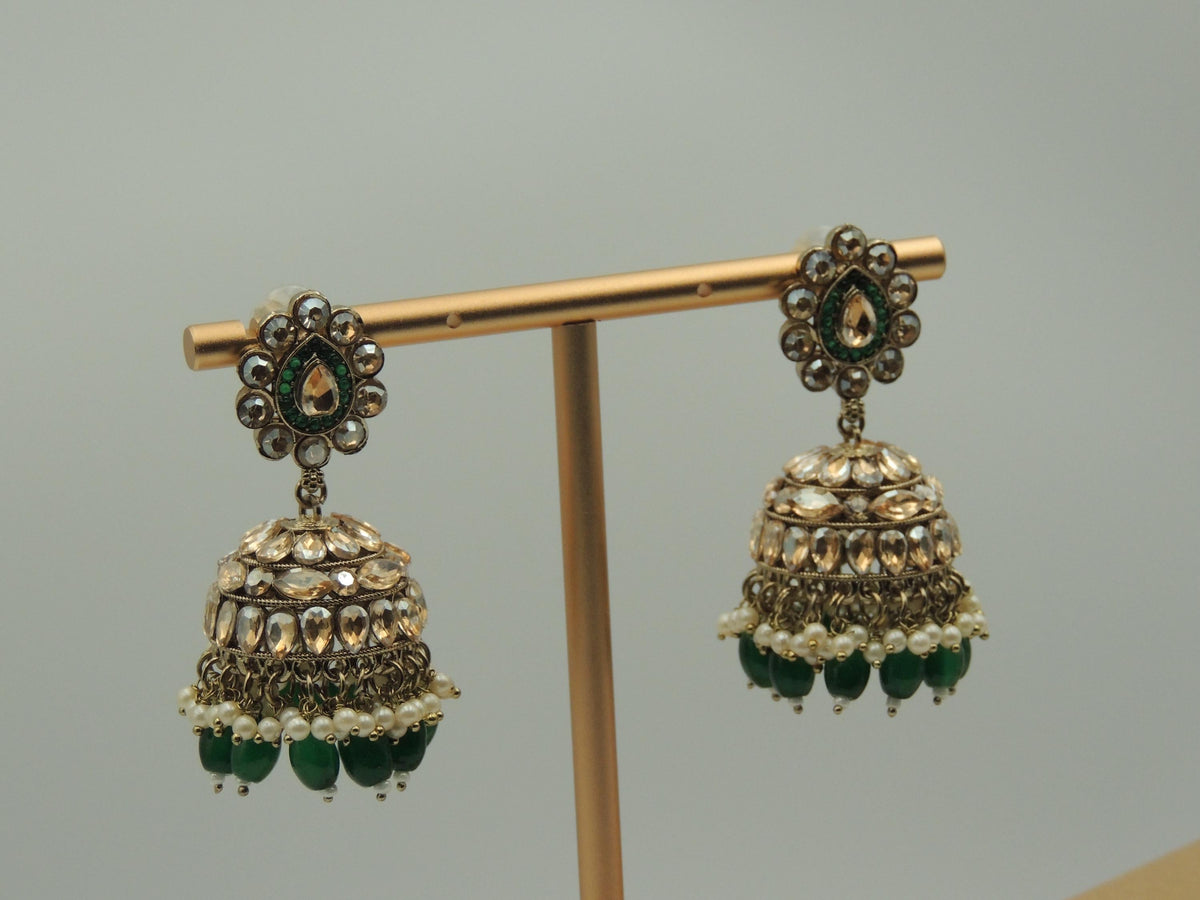
A jhumka is recognized by its bell-like or domed pendant. That hanging volume is the feature to look for first: it gives the earring a rounded profile beneath the ear, often finished with smaller dangling details. The dome can appear in a simple pair of earrings or as one part of a much more elaborate ornament.
Rather than treating every traditional-looking drop as a jhumka, look at how the shape is built. A circle, a crescent and a dome create different outlines. Some designs combine them, which is why a single label does not always describe everything you see.
A historical example with a surprising attachment
The Metropolitan Museum of Art's eighteenth- to nineteenth-century hair and ear ornament includes bell-shaped pendants identified as jhumkas. The museum explains that hooks attached the ornament to hair or a headband, placing it beside the face near the ears. It belonged to the collection assembled by artist and designer Lockwood de Forest during travels in India in 1879–1881.
This is a documented collector connection, not proof that de Forest wore the piece or that it belonged to a named royal person. Its interest is in the construction: an ornament associated visually with the ear could also depend on the hairstyle for its placement.
Read a jhumka from top to bottom
Start with the upper attachment. A stud-like section may sit close to the ear, while a hook or longer connector changes where the dome begins. Then look at the dome itself. Is it broad and shallow, narrow and deep, open around its lower edge, or densely ornamented?
Finally, examine the fringe. A row of small beads makes a different visual rhythm from a few larger drops. Hanging elements also extend the overall length beyond the dome. When comparing measurements, make sure the stated length includes the complete earring rather than only its central section.
These observations explain why two pairs both called jhumkas can feel very different with the same outfit. The word describes a recognizable form, not one fixed size or weight.
What the shape can—and cannot—tell you
A dome may look substantial even when its construction is relatively open. Conversely, a compact piece can still feel heavy. Do not estimate weight from the photograph, and do not assume that a traditional outline establishes gold, silver, pearls or gemstones.
The Naaz earrings in the cover image are a contemporary example of the domed silhouette. Their photograph is a design reference, not an illustration of the Met object. For material and closure information, use the individual listing rather than the historical example.
Styling the bell without losing the detail
A jhumka's outline is easiest to appreciate when there is room around it. Try the earrings with your intended hairstyle and neckline. With loose hair, check whether the dome remains visible. With hair pinned back, look at the full connection between the ear and the pendant.
Turn your head and notice whether the fringe touches your collar or shoulder. This is especially useful with raised embroidery, a scarf or a dupatta. The goal is comfortable movement, not a rule that a particular face shape must wear a particular earring.
If the neckline is already elaborate, try the earrings alone before adding a necklace. If you add a necklace, leave enough visual space that its upper edge and the earring drops remain distinct. You can explore the Jhumka collection for variations in proportion.
Are jhumkas only bridal jewelry?
No single occasion defines the form. A wearer can choose a small or statement design according to the event, outfit and personal preference. It is more useful to ask whether a particular piece is comfortable for the planned activity than to assume its name limits who may wear it.
How are they different from chandbalis?
A chandbali emphasizes a crescent, while a jhumka emphasizes the domed drop. Some earrings combine both. The jhumka and chandbali comparison looks more closely at that distinction and how it affects styling.