Kada and Bangle: Understanding the Difference
A kada is commonly described as a substantial wrist ornament, while “bangle” is a broader term for a rigid bracelet. The distinction is useful, but it is not a universal sizing system. A name does not tell you whether a piece opens, how wide it is, or whether it can pass comfortably over your hand.
Start with the object's construction. Then use the name as context. This approach lets you appreciate the design without confusing a familiar word with a guarantee of fit.
A historic kada with delicate details
The National Museum in New Delhi records a nineteenth-century gajredar kada from Bikaner: a hinged gold bangle combining gemstones, enamel and pearl details. It is a useful reminder that a substantial wrist ornament can also depend on small, carefully arranged components.
The record documents a place, period and object, rather than a named royal wearer. Its value here is as a specific example. It should not be used to claim that every kada has the same materials, meaning or construction.
Closed, hinged or open?
A closed bangle has to pass over the hand. A hinged design opens and closes around the wrist. An open cuff has a gap, but that gap does not automatically mean the metal is intended to bend. These differences are more important to fit than whether a seller chooses “kada,” “kangan” or “bangle” in the title.
Look at the fastening in a close-up photograph. If it opens, ask how it is secured and whether the closure needs particular handling. If it is closed, compare the inside opening with a piece you already wear comfortably. For an oval shape, one diameter alone may not describe the fit.
Width changes the experience
Imagine two bangles with the same inside opening: one narrow and one broad. They can occupy different amounts of space on the wrist even before you consider their decoration. A stack adds another variable because neighboring pieces move against one another.
Rather than choosing by the most impressive photograph, think about what your hands will be doing. A broad piece may meet a sleeve differently from several fine bangles. Dangling details can extend well beyond the rigid band. Neither arrangement is inherently better; each asks for a different amount of room.
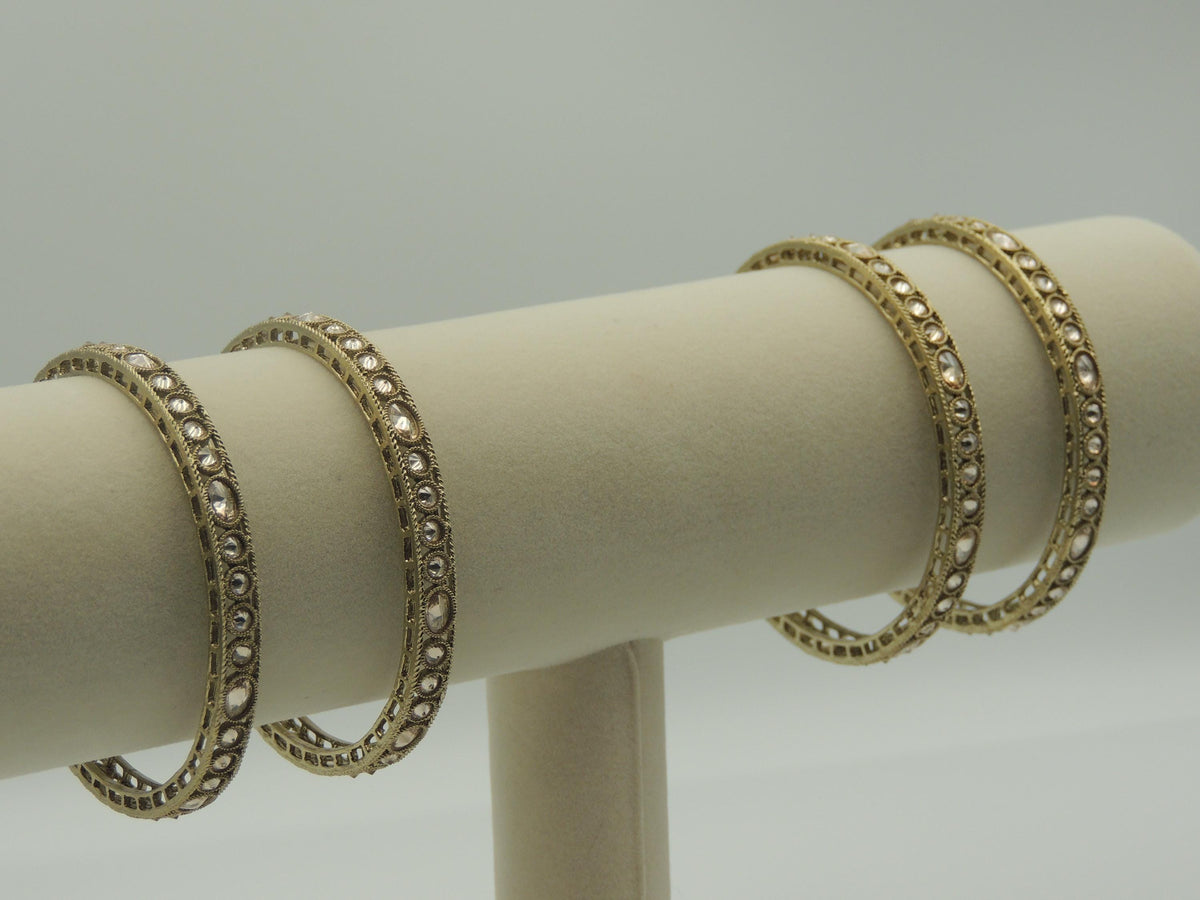
The cover photograph shows contemporary Ishani bangles, not the Bikaner museum object. Use it to compare decorative repetition and width, while checking the actual product's materials and dimensions separately.
Cultural meaning needs a specific context
Wrist ornaments can be personal adornment, part of an occasion outfit or connected with a community's customs. Avoid assuming that every ornament described as a kada has the same religious or marital meaning. A particular family tradition is more informative than a universal statement about all South Asian wearers.
If you are choosing a piece for a ceremony, ask which form is expected and why. That conversation can distinguish a meaningful requirement from a visual preference. It also leaves room for inherited pieces whose significance may not be apparent in a product photograph.
Building a balanced stack
Try the main piece first, then add neighboring bangles one at a time. Notice the total width, how the surfaces touch and whether the stack interferes with the sleeve. Stop when the arrangement feels complete rather than assuming more pieces make it more ceremonial.
Repeating one finish or motif can connect a mixed stack. You do not need every band to have the same width. A quieter neighboring piece can leave the main ornament's detail easier to see.
Compare construction in Bangles & Bracelets, and use the jewelry sizing and fit guide when gathering measurements.
Does adjustable mean one size fits everyone?
No. Ask about the stated adjustment range and how adjustment is intended to work. A small gap or a hinge does not establish unlimited flexibility. Do not force a rigid ornament to fit.
Is a pair always included?
Not necessarily. Read the named contents and quantity. A photograph showing several wrist ornaments may be demonstrating a stack, so confirm whether the listing is for one piece, a pair or a larger set.