Mughal Emeralds: Why Gems Were Carved
A gemstone does not need a field of sparkling facets to hold your attention. On a carved emerald, the surface can become an image: a plant, a flower or a pattern worked into the stone itself. The gem remains a material, but it is also the support for a design.
Mughal carved emeralds make this distinction especially clear. Understanding them means looking beyond size and color to consider the relationship between carving, attachment and historical evidence.
An emerald with two decorated faces
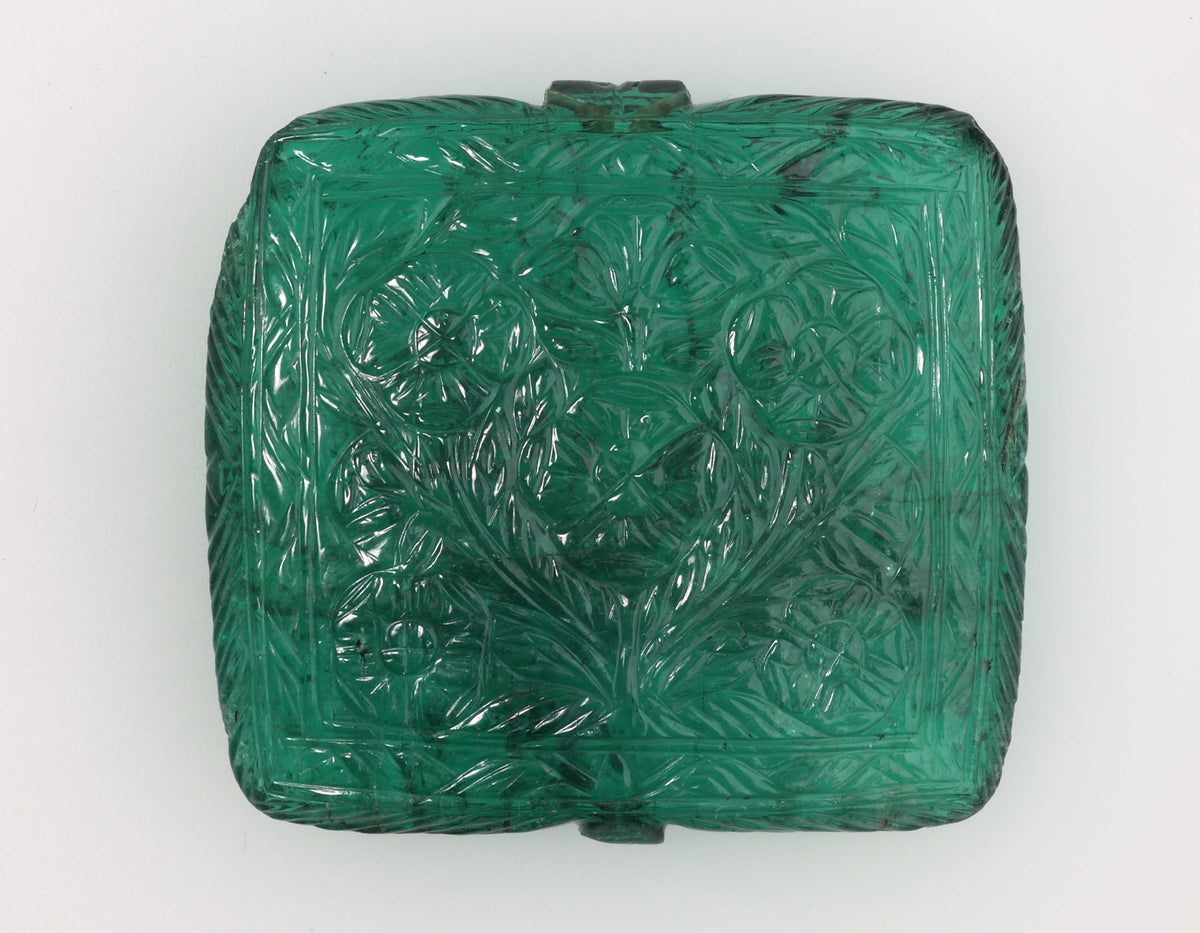
The Khalili Collections records emerald pendant JLY 1856 as a Colombian emerald carved in Mughal India around 1650–75. One face shows a stylized flowering plant; the reverse has a double rosette. The catalog gives its weight as 164.33 carats.
Small pierced projections at the edges are interpreted in relation to its use as a pendant. The record associates this group of large carved emeralds with royal Mughal workshops, but does not identify an individual who wore this particular piece. That is a useful boundary: a documented workshop context is not the same as a named owner's story.
Cover image: Emerald Pendant, JLY 1856. Khalili Collections / CC BY-SA 3.0 IGO. Original photograph used without retouching; displayed to fit this page.
Carving and faceting create different experiences
Facets divide a surface into geometric planes. Carving can instead create raised and recessed areas that describe an image. When you look at a photograph of a carved gem, notice the shadows along the design as well as the gem's overall color.
A shallow flower can become clearer when the light comes from one direction and less distinct when the surface reflects directly toward you. This is one reason a single bright product photograph may not communicate the work well. A second angle can reveal details that disappear in a frontal view.
Do not assume that a carved surface proves an object's age or geographic origin. A modern maker can carve a gem too. Dating and attribution require evidence beyond resemblance to a historic floral pattern.
A jewel can have more than one chapter
A stone and its setting do not always share a date. GIA's report on the Smithsonian gem collection describes the Murdock emerald as a carved stone thought to have traveled from Colombia to India before being mounted in a twentieth-century Parisian necklace. The likely earlier history and the later setting are presented as distinct parts of the object's story.
That example changes the questions worth asking. Instead of “How old is this necklace?” there may be separate questions about the gem, the carving, the mounting and later alterations. Preserve words such as “probably” when a collection record uses them. Removing that qualification creates certainty the evidence does not supply.
What a close-up can and cannot tell you
Look for the edges of the motif, the places where it meets the surrounding surface, and any visible attachment points. These details help explain the design. They do not certify gemstone identity, disclose every treatment or establish provenance.
For a valuable gem offered for sale, a detailed description and appropriate independent documentation matter more than a dramatic historical comparison. A piece described only as emerald-colored should not be assumed to contain emerald. Color language and material identification are different claims.
The same care applies to setting terminology. The guide to kundan and polki explains why the name of a construction method cannot identify every stone used within it.
Looking at modern pendants differently
You can apply this way of looking without trying to imitate an imperial jewel. In a contemporary pendant, ask whether the character comes from the surface, the outline, the surrounding border or the way it hangs. Those are useful design questions at any price.
When comparing necklaces and chokers, consider where the main detail rests against your clothes and whether it remains visible as you move. A quiet setting can give an intricate surface room to be seen. The most revealing detail is sometimes not how much a jewel sparkles, but what becomes visible when you look a little longer.