Granulation: The Tiny Details in Indian Goldwork
Some of the most interesting details in a gold ornament are also the smallest. A row of tiny rounded forms can define an edge, fill a surface or lead your eye around a curve. In granulation, small metal granules become part of the decorative construction.
You may first notice their combined texture rather than each individual element. Looking closer reveals how these small details interact with larger shapes, wirework and figures.
An ancient Indian example survives
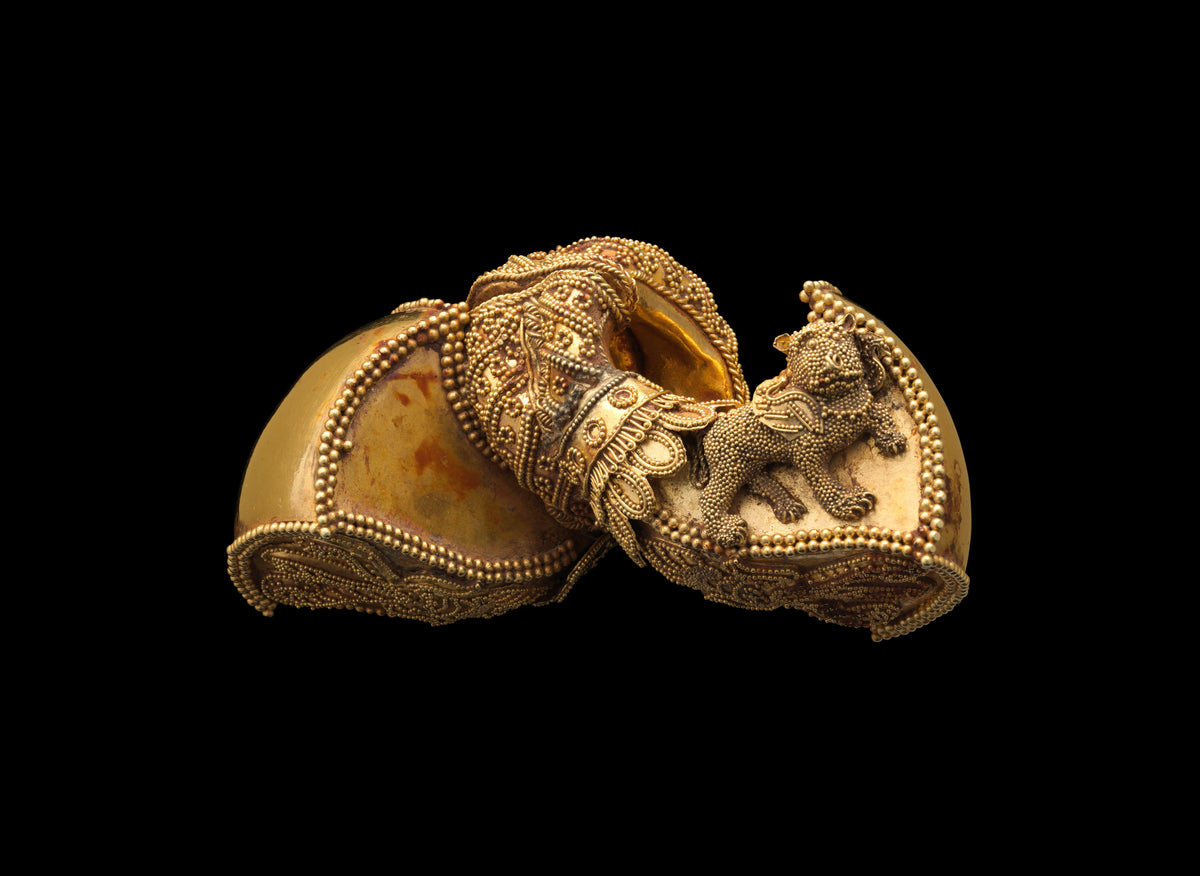
The Metropolitan Museum of Art preserves a Satavahana ear ornament from Andhra Pradesh, dated around the first century BCE–first century CE. Its recorded materials and techniques include gold sheet, wire and granulation. The curving form is decorated with small details, including animal imagery.
The museum interprets the quality and imagery as suggesting royal ownership. It does not identify a particular wearer. Its discussion also connects the broader ornament type with ancient literature and sculpture; a literary parallel should not be confused with proof that a named epic character owned this surviving object.
Cover image: One from a Pair of Ear Ornaments, Andhra Pradesh, Satavahana period. The Metropolitan Museum of Art, object 1981.398.3. Public domain.
Three scales of decoration
Begin with the outer silhouette. The main curve gives the ornament its overall form. At this distance, the small granules may merge into a textured band.
Move closer and look for the intermediate details: bands, borders, relief figures and wire. These organize the surface into separate areas. They can direct attention toward the ends of the ornament or emphasize a transition between one part and another.
Finally inspect the smallest repeated forms. Are they arranged in a row, clustered into a pattern or spread across a field? A small change in their placement can sharpen a border or soften the visual transition around a curved surface. This layered way of looking makes a complex object easier to read.
Granulation, wire and an imitation texture
The terms in a museum record can help distinguish the processes that contribute to an object. Wire can create a continuous line; granules create a sequence of individual rounded elements. On a finished surface, the two may work together so closely that their contributions are easy to overlook.
A dotted surface on modern jewelry does not automatically prove traditional granulation. Casting or other manufacturing methods can produce a related visual texture. Ask how a piece was made if the process matters to your choice. A clear description can acknowledge a granulated effect without claiming a technique that has not been verified.
This is not a contest between handmade and other production. It is a question of accurate naming. You can enjoy the texture of a contemporary piece while understanding that a historical object's construction may be different.
Light reveals the pattern
Small rounded forms create a rhythm of highlights and shadows. In a very bright frontal photograph, those details may flatten into a uniform shine. A second angle can reveal their spacing more clearly.
When comparing images, look for readable detail rather than maximum sparkle. A photograph that shows an edge, joint or back surface may be more informative than one with dramatic lighting. The purpose is to understand the object, not to mistake photographic contrast for workmanship.
For an earring, also distinguish surface detail from wearing scale. A close-up can make a small component appear monumental. Check the stated dimensions and fastening separately. The jhumka history guide offers another example of how an earring's overall form and its smaller decorative details work together.
What can you notice in modern jewelry?
Try comparing two earring designs with a similar overall outline. One may rely on smooth surfaces, another on repeated beads or dots. Their dimensions can be comparable while their visual density differs considerably.
Consider which effect is easiest to see against your hairstyle and outfit. A textured border may read clearly beside plain fabric but become quieter near dense embroidery. There is no requirement to maximize detail in every accessory.
The ancient ornament rewards close attention because its smallest elements are not incidental. They participate in the shape of the whole object. Learning to notice that relationship is useful even when the modern jewelry in front of you uses entirely different materials or methods.