Thewa Jewelry: A Scene Written in Gold and Glass
At first glance, thewa can look like a golden drawing against a jewel-colored background. Look closer and the image becomes more intricate: a figure sits among trees, an animal turns beneath a branch, or a border frames a miniature scene.
Thewa is a craft associated with patterned gold foil and colored glass. Its interest lies in the relationship between the two: the open spaces in the metal allow the background to become part of the picture.
A bracelet from Pratapgarh
The Metropolitan Museum of Art records a nineteenth-century thewa bracelet made in Pratapgarh, Rajasthan. Its description identifies pierced gold foil over glass, with scenes involving Hindu subjects and animals against green glass.
The museum also recounts an origin tradition attributed to local craftsmen, naming a goldsmith and an eighteenth-century date. That is a recorded craft tradition, rather than a reason to claim that every stage of the technique's early history is settled. What the surviving bracelet establishes directly is the use of delicate metalwork and colored glass in a documented nineteenth-century object.
Why the empty spaces matter
In an opaque metal panel, decoration may be worked into the surface. In thewa, the relationship between the design and the spaces around it is especially visible. The colored background outlines leaves, figures and other small forms.
Try looking first at the dark or colored gaps rather than the gold. The pattern may become easier to read. Then return to the metal lines and follow how separate details remain connected within the composition. A scene that seems crowded at first can resolve into a carefully organized network.
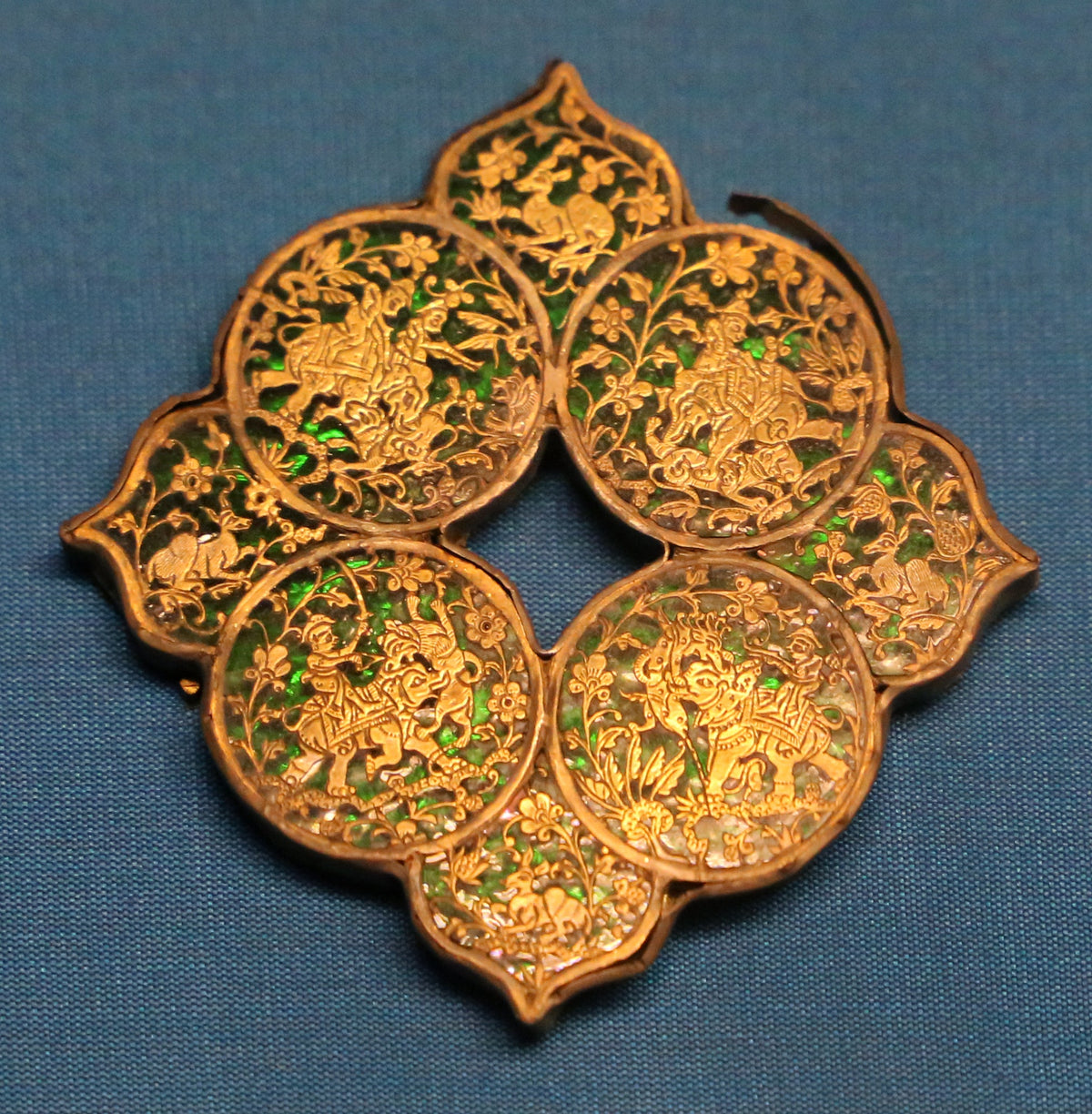
The cover photograph shows a separate decorative thewa plaque, not the Met bracelet. Its figures, animals and foliage offer a useful example of a narrative composition extending beyond a single small pendant.
Image credit: Sailko, thewa decorative plaque, via Wikimedia Commons, CC BY 3.0. Photograph used without retouching and displayed to fit the page.
Thewa is not simply another word for enamel
Both techniques can bring color and metal together, but the name should describe the actual process. In thewa, the worked metal design is associated with the glass backing. The guide to meenakari explores enamel as a different way of creating color on jewelry.
A photograph can show the effect without fully explaining the construction. Ask how the surface was made if the technique is important to you. A printed imitation, a painted surface and traditional pierced-metal work may share a broad color scheme while being materially different objects.
Read the scene at two distances
From farther away, the shape and contrast may dominate. Up close, the subject becomes more important. Identify the largest forms first, then inspect the smaller details around them. A border may be purely ornamental while the center tells a story.
Avoid naming a particular deity, court or historical event solely from a distant image. If a collection record identifies the subject, use that description. Otherwise, a careful account of what is visibly present—figures, animals, plants—is more accurate than a confident but unsupported narrative.
Choosing a contemporary piece
For a modern thewa item, ask who made it, how the technique is described, and what materials form the complete object. The patterned panel, frame, chain and clasp do not necessarily have identical compositions. A claim about the decorative foil should not be treated as a statement about every component.
Look at the edge as well as the center. Does the frame protect and finish the panel cleanly? Is the fastening shown? Can you see the scale beside a hand or another reliable reference? These details help translate a close-up photograph into something understandable to wear.
Give the small scene room to be seen
A strongly patterned jewel can work against a quieter area of fabric, allowing its details to remain visible. When comparing wrist jewelry, consider how a patterned face turns as your hand moves, rather than judging only a straight-on photograph.
Thewa rewards that second look. Its appeal is not limited to a bright color or precious material: it is the way a small worked surface can carry a surprisingly complete visual world.