Article: Meenakari: Why the Back of a Jewel Matters
Meenakari: Why the Back of a Jewel Matters
Meenakari is an enameling tradition: color becomes part of a metal surface rather than appearing only as a separate stone. To appreciate it, turn the jewel over. In some historic Indian work, the surface against the body carries carefully arranged decoration that is almost invisible when the piece is worn.
That reversal changes how you look at jewelry. The visible face may emphasize bright stones, while the reverse rewards a closer and more private inspection. A necklace can be designed for both the room and its wearer.
Enamel is not simply colored paint
GIA's guide to enameling techniques describes enamel as glass fused onto a metal support. Different methods organize the material in different ways: metal boundaries can separate areas of color, recesses can hold it, and transparent enamel can reveal texture underneath.
The important distinction is between a manufacturing process and a similar-looking surface. A colorful coating is not automatically traditional fired enamel. Modern listings may use broad decorative language, so ask how the surface was made if craftsmanship is central to your choice.
Why decorate the hidden side?
The V&A's account of Indian jewelry making describes Mughal court goldsmiths combining stone setting and enamel in the late sixteenth century, including decoration on the back or inner surfaces. Its films follow present-day craftspeople continuing these practices.
The historical example is a workshop tradition rather than a claim about a particular celebrity's jewel. The appeal does not require an invented royal owner or an unverifiable price: the extra attention given to a normally hidden surface is compelling in itself.
A necklace with a floral reverse
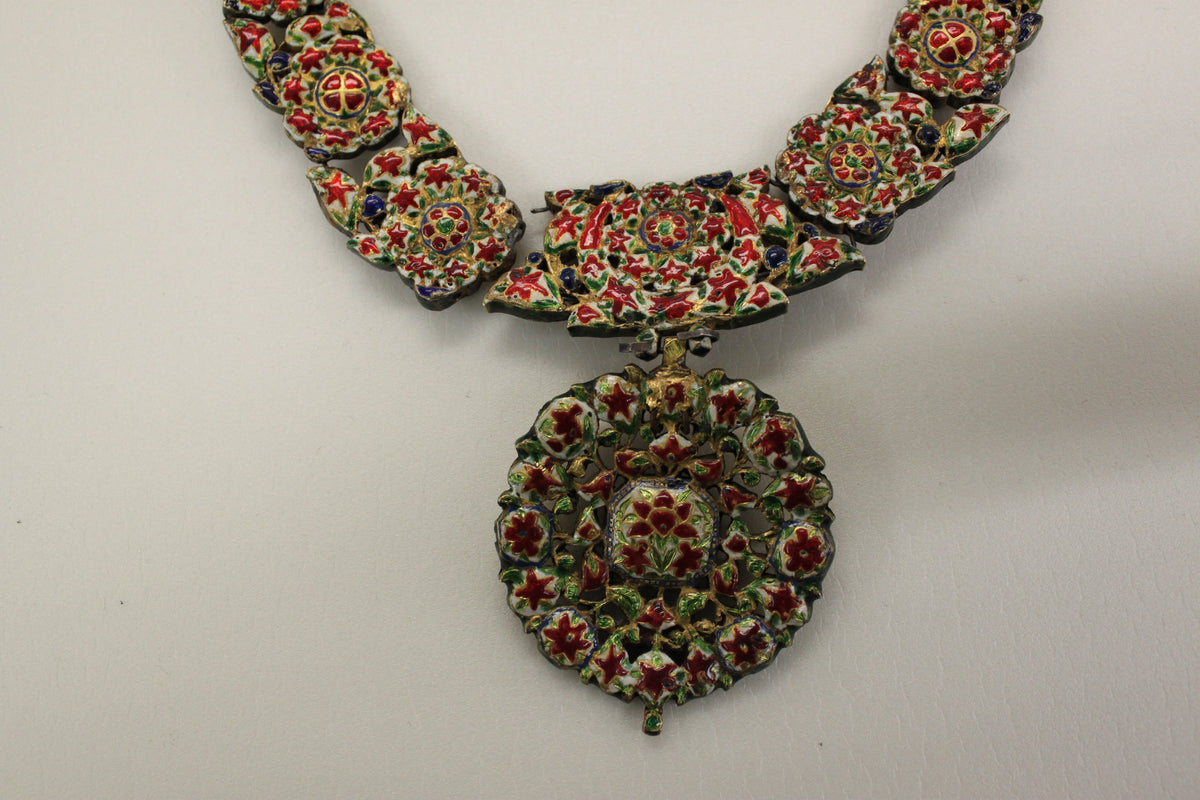
The Metropolitan Museum of Art records an eighteenth-century necklace attributed to India, probably Jaipur. Its gold, enamel and silk construction offers a concrete example to examine. The reverse photograph reveals red flowers, green details and blue accents arranged across the linked elements.
Cover image: enamel reverse of necklace 19.111.3, The Metropolitan Museum of Art. Public domain. The photograph shows the historical object discussed here, not a current Chamak product.
How enamel and stone setting work together
A stone and its setting create one kind of structure. Enamel can supply color in the spaces around that structure or across another face of the jewel. That is why meenakari and kundan can appear in descriptions of the same object without meaning the same thing.
If you have read the guide to kundan and polki, add enamel as a third question: what decorates the surface? Separating the material, the setting and the surface prevents one prestigious craft name from standing in for all the information about a piece.
Look at the reverse with purpose
Ask for a back view rather than treating it as an optional product photograph. Look at the layout, the edges of colored areas and the places where the surface meets hinges or connecting parts. A reverse view also helps you understand which elements touch the skin and how the necklace is assembled.
These are visual observations, not a way to authenticate an antique from a screen. Wear, restoration, surface condition and materials may need specialist examination. A photograph of a bright floral reverse cannot, by itself, establish its age or the technique used.
Color without overcrowding
For contemporary styling, begin with one enamel color and see how it relates to your clothing. Repeating that accent can make the combination feel connected without matching every shade. Alternatively, let the jewelry supply the main color against quieter fabric.
If the most colorful surface is on the reverse, do not assume the piece is intended to be worn both ways. A reversible design needs appropriate construction and fastenings; decoration alone does not make the two sides interchangeable.
When comparing modern necklaces and chokers, ask for photographs of both faces and read the stated technique. That information helps you distinguish an enamel surface from a similar color effect while appreciating the design on its own terms.